
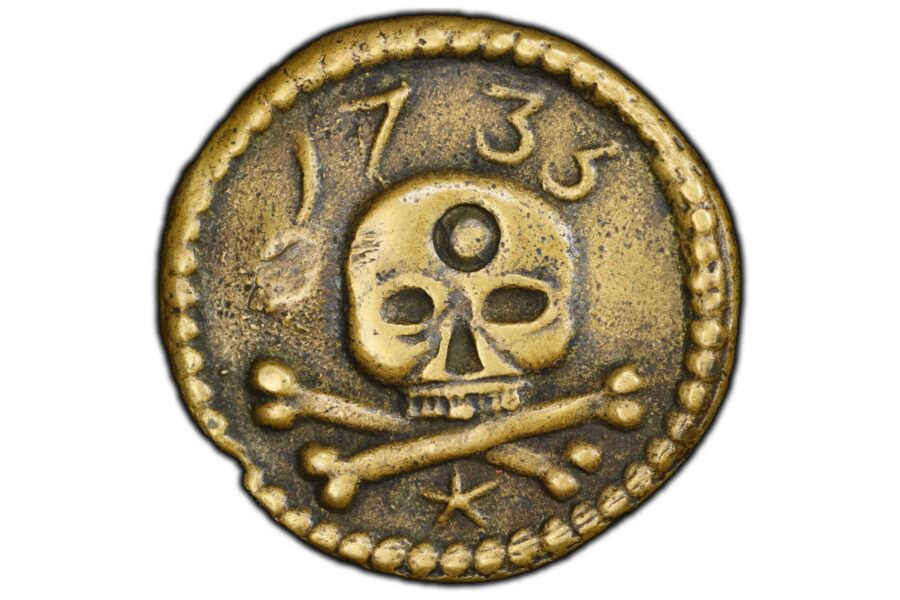
When it comes to Memento Mori tokens, few can compare with the iconic images displayed on the rare 1733 Saint Martin’s variety.
Known in Dutch as a Begrafenisloodje (Funeral lead), this token was used as payment for funeral expenses at the Church of Saint Martin located in the historic Wyck district of the city of Maastricht, Netherlands.
The design of the token would have been dictated by the church leadership and given to a local blacksmith or minter to engrave the mold and cast the tokens.
The Obverse Design:
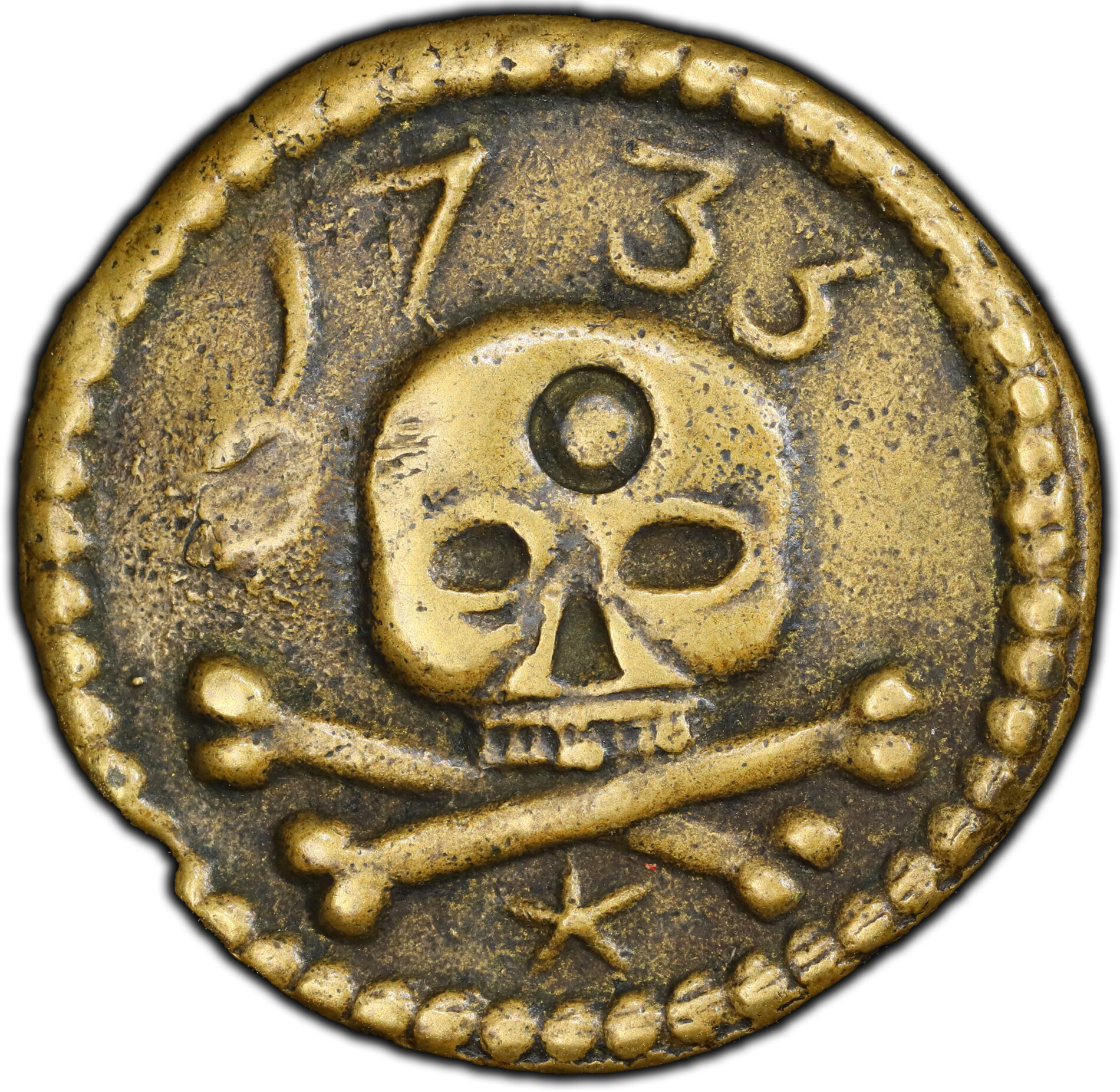 On the obverse side of the token you see a skull resting over crossed bones, which is a classic memento mori symbol. Memento mori is a Latin term for “Remember death” or “remember you must die.” It is a reminder that mankind is mortal and that life here on Earth will have consequences hereafter. The Saint Martin token is a similar design to funeral or communion tokens minted from 1635 to about 1700 for the church of Saint Lambert, which is located near Maastricht in the city of Liège.
Some of the characteristics that make Saint Martin tokens different from Saint Lambert tokens are:
1) Saint Martin tokens are much rarer and only come in one variety versus 5 types of Saint Lambert’s.
2) They are considerably larger at roughly 32 mm in diameter versus 20 mm.
3) They are considerably heavier. Saint Martin’s weigh roughly 13.15 grams versus roughly 4.25 grams.
4) They were made of brass versus copper.
5) Saint Martin tokens were cast versus being made with a screw press. (For more information on the Memento Mori tokens of Saint Lambert, see our article titled “A Fascinating Look Into Saint Lambert’s Communion Tokens” here: https://commodorecoins.com/treasure-blog/an-in-depth-look-into-saint-lamberts-communion-tokens/
On the forehead of the skull is a circular redemption counterstamp and below the skull and crossed bones is a five-pointed star.
The Inspiration Behind the Design – The Skull and Crossed Bones
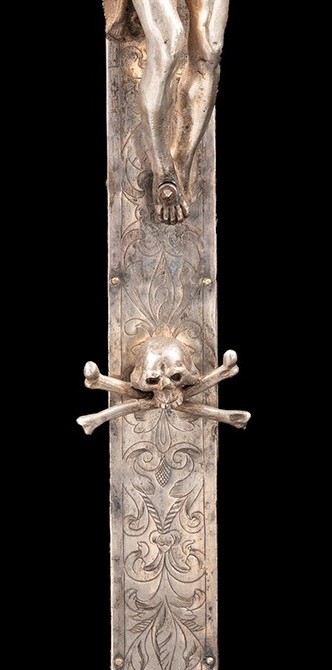
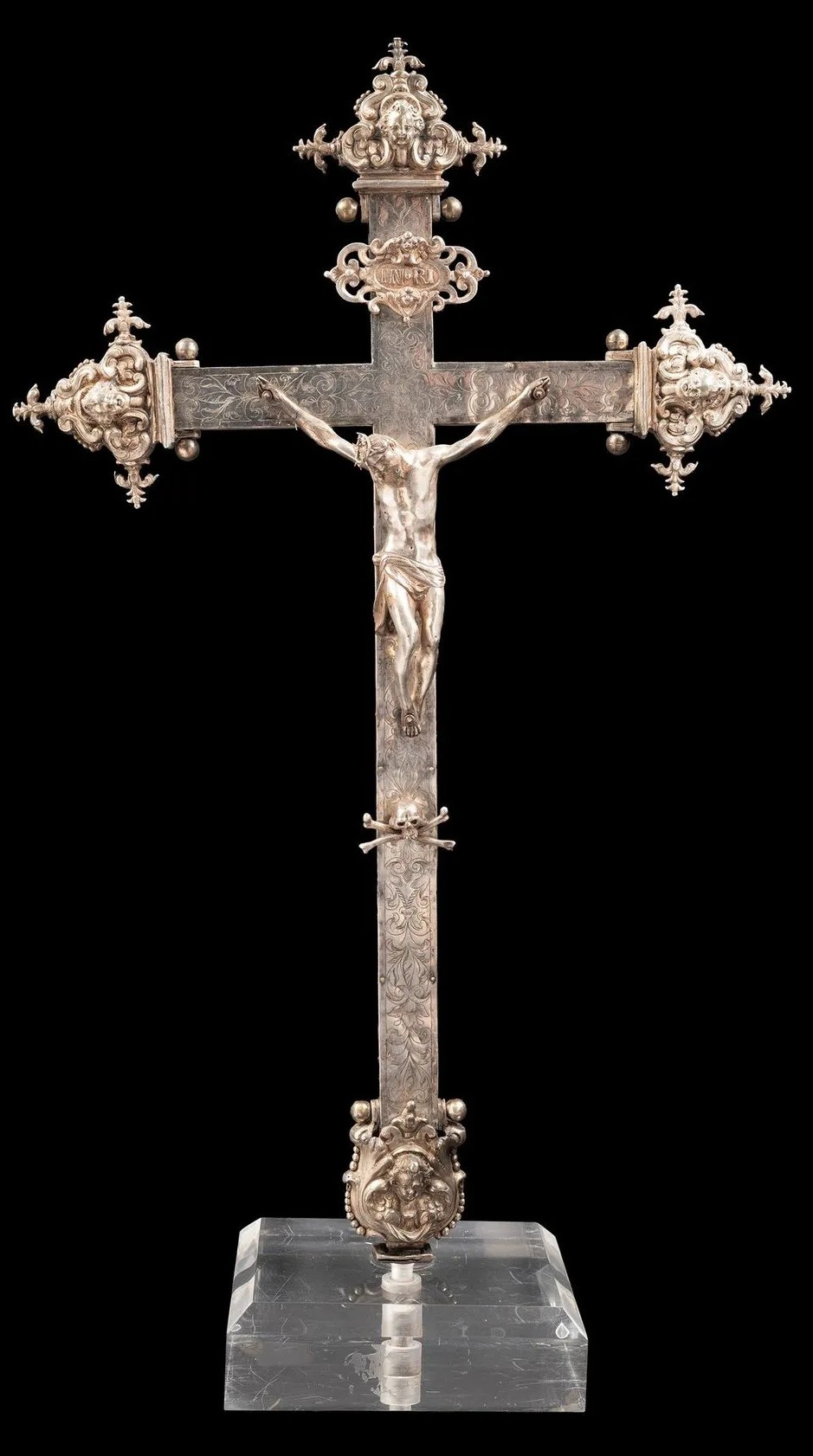 To get a better feeling of what may have gone through the mind of the designers of these tokens, you have to remember that they were specifically made for the Church of Saint Martin in 1733 for use at a funeral or funerals. Crucifixes from the 17th and 18th century often displayed a skull and crossed bones below the body of Christ on the cross as depicted in this example to the left.
When used by the church, the skull and crossed bones imagery is a reference to Christ’s victory over death, which was prophesied roughly 700 years before Jesus was born. This is illustrated in the 53rd chapter of the book of Isaiah, a chapter in the Old Testament often referred to as “the forbidden chapter“. It reads: “Who has believed our message and to whom has the arm of the Lord been revealed? 2 He grew up before him like a tender shoot, and like a root out of dry ground. He had no beauty or majesty to attract us to him, nothing in his appearance that we should desire him. 3 He was despised and rejected by mankind, a man of suffering, and familiar with pain. Like one from whom people hide their faces he was despised, and we held him in low esteem. 4 Surely he took up our pain and bore our suffering, yet we considered him punished by God, stricken by him, and afflicted. 5 But he was pierced for our transgressions, he was crushed for our iniquities; the punishment that brought us peace was on him, and by his wounds we are healed. 6 We all, like sheep, have gone astray, each of us has turned to our own way; and the Lord has laid on him the iniquity of us all. 7 He was oppressed and afflicted, yet he did not open his mouth; he was led like a lamb to the slaughter, and as a sheep before its shearers is silent, so he did not open his mouth. 8 By oppression and judgment he was taken away. Yet who of his generation protested? For he was cut off from the land of the living; for the transgression of my people he was punished.9 He was assigned a grave with the wicked, and with the rich in his death, though he had done no violence, nor was any deceit in his mouth. 10 Yet it was the Lord’s will to crush him and cause him to suffer, and though the Lord makes his life an offering for sin, he will see his offspring and prolong his days, and the will of the Lord will prosper in his hand.11 After he has suffered, he will see the light of life and be satisfied; by his knowledge my righteous servant will justify many, and he will bear their iniquities. 12 Therefore I will give him a portion among the great, and he will divide the spoils with the strong, because he poured out his life unto death, and was numbered with the transgressors. For he bore the sin of many, and made intercession for the transgressors.”
 The fulfillment of this prophesy is documented in all four gospels and in the book of Matthew chapter 27, it reads: “They came to a place called Golgotha (which means “the place of the skull”). 34 There they offered Jesus wine to drink, mixed with gall; but after tasting it, he refused to drink it. 35 When they had crucified him, they divided up his clothes by casting lots. 36 And sitting down, they kept watch over him there. 37 Above his head they placed the written charge against him: this is Jesus, the king of the jews. 38 Two rebels were crucified with him, one on his right and one on his left. 39 Those who passed by hurled insults at him, shaking their heads 40 and saying, “You who are going to destroy the temple and build it in three days, save yourself! Come down from the cross, if you are the Son of God!” 41 In the same way the chief priests, the teachers of the law and the elders mocked him. 42 “He saved others,” they said, “but he can’t save himself! He’s the king of Israel! Let him come down now from the cross, and we will believe in him. 43 He trusts in God. Let God rescue him now if he wants him, for he said, ‘I am the Son of God.’” 44 In the same way the rebels who were crucified with him also heaped insults on him. 45 From noon until three in the afternoon darkness came over all the land. 46 About three in the afternoon Jesus cried out in a loud voice, “Eli, Eli, lema sabachthani?” (which means “My God, my God, why have you forsaken me?”). 47 When some of those standing there heard this, they said, “He’s calling Elijah.” 48 Immediately one of them ran and got a sponge. He filled it with wine vinegar, put it on a staff, and offered it to Jesus to drink. 49 The rest said, “Now leave him alone. Let’s see if Elijah comes to save him.” 50 And when Jesus had cried out again in a loud voice, he gave up his spirit. 51 At that moment the curtain of the temple was torn in two from top to bottom. The earth shook, the rocks split 52 and the tombs broke open. The bodies of many holy people who had died were raised to life. 53 They came out of the tombs after Jesus’ resurrection and went into the holy city and appeared to many people. 54 When the centurion and those with him who were guarding Jesus saw the earthquake and all that had happened, they were terrified, and exclaimed, “Surely he was the Son of God!”
The Significance of the Five-Pointed Star:
The five-pointed star symbol located under the crossed bones also has a biblical significance. In the book of Revelation chapter 22 verse 16, Jesus said, “I, Jesus, have sent my angel to give you this testimony for the churches. I am the Root and the Offspring of David, and the bright Morning Star“. In John Chapter 8:12, Jesus said “I am the light of the world. Whoever follows me will never walk in darkness, but will have the light of life.” The star symbolizes Christ as the greatest light that shines out of the darkness that leads mankind to salvation.
The five-pointed upright star also represents the five wounds of Jesus Christ (One nail puncture wound through each hand, one through each foot, and the wound in his side from the Roman centurion’s spear). The star placed below the skull symbolizes that through Christ’s wounds and sacrifice he triumphed over death, and through faith in him, the deceased has achieved eternal life.
The Function of the Counterstamp:
In the center of the skull on the obverse is a circular counterstamp, which indicates that the token had been redeemed. This was primarily done with a hammer and steel punch to prevent tokens from being reused. Funeral tokens were typically used as a form of attendance tickets that allowed the holder to partake in food, drink, or mourning gifts and entitlement to participate in the funeral procession. They were also used as a form of payment for gravediggers and pallbearers.
These tokens ensured that only invited guests or authorized mourners received funeral goods and services. This prevented outsiders from showing up for free food or creating chaos at the wake or funeral procession.
The Reverse Design – Who Was Saint Martin?
On the reverse side of the token, you see displayed in the center an image representing Saint Martin of Tours (c. 316–397) depicted riding a horse and cutting his cloak with a sword and giving the cut portion to a poor man standing behind with a crutch. At the outer rim of the token you see the words St. Martini (Saint Martin) and another counterstamp at the horse’s shoulder.
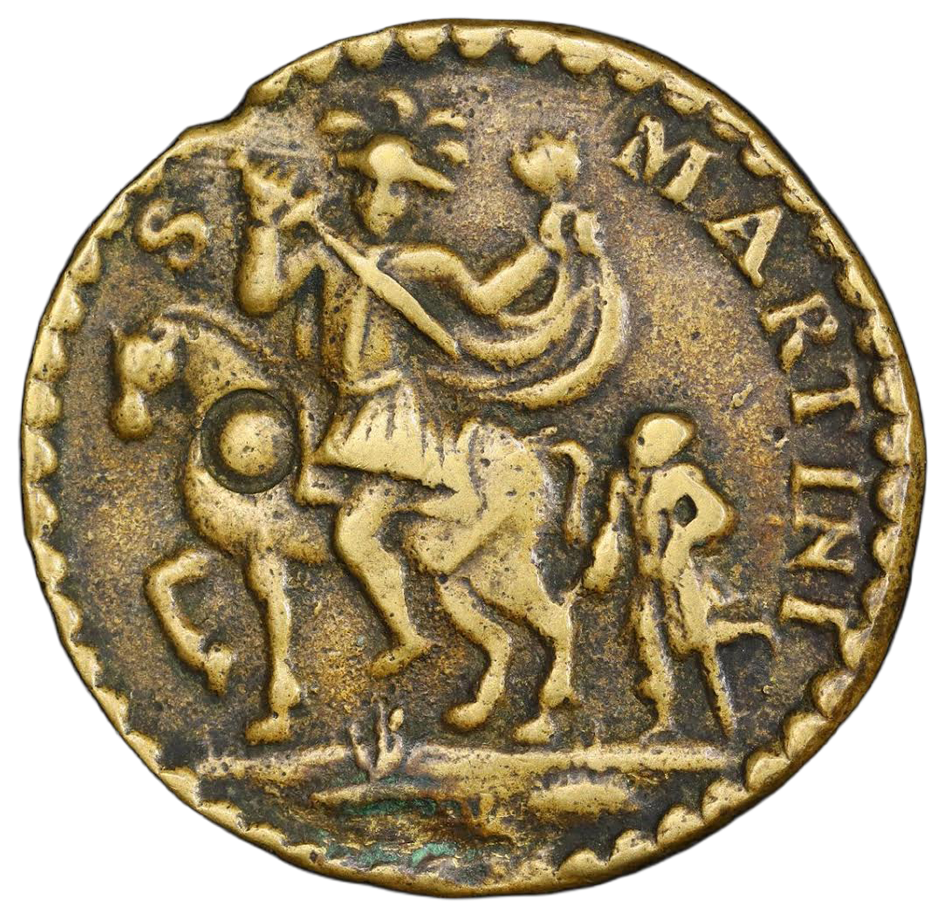 St. Martin of Tours was one of the most beloved saints in Western Christianity. St. Martin was the third bishop of Tours, France and is the patron saint of many communities and organizations across Europe.
Sulpicius Severus (c. 363 – c. 425), was a contemporary Christian writer who knew Martin personally, documented the early life of the saint. It contains descriptions of supernatural events, such as interactions with the devil and numerous miracles: Martin casts out demons, heals a paralytic, and on multiple occasions raises the dead. These acts are identical to the commission Jesus gave the apostles in the book of Matthew chapter 10 verse 8 where Jesus states: 8 Heal the sick, cleanse the lepers, raise the dead, cast out devils: freely ye have received, freely give.” Other miracles Saint Martin performed include: turning back the flames from a house while Martin was burning down the pagan Roman temple it adjoined; deflecting the path of a felled sacred pine, and the healing power of a letter written by Martin. The miracle of the letter was again proof of God working through Martin that was similar to the miracles performed by the apostles, such as those done by the Holy Spirit through Saint Paul written in the book of Acts Chapter 19 versus 11 and 12, where it states “11 God did extraordinary miracles through Paul, 12 so that even handkerchiefs and aprons that had touched him were taken to the sick, and their illnesses were cured and the evil spirits left them.”
Saint Martin Dividing His Cloak:
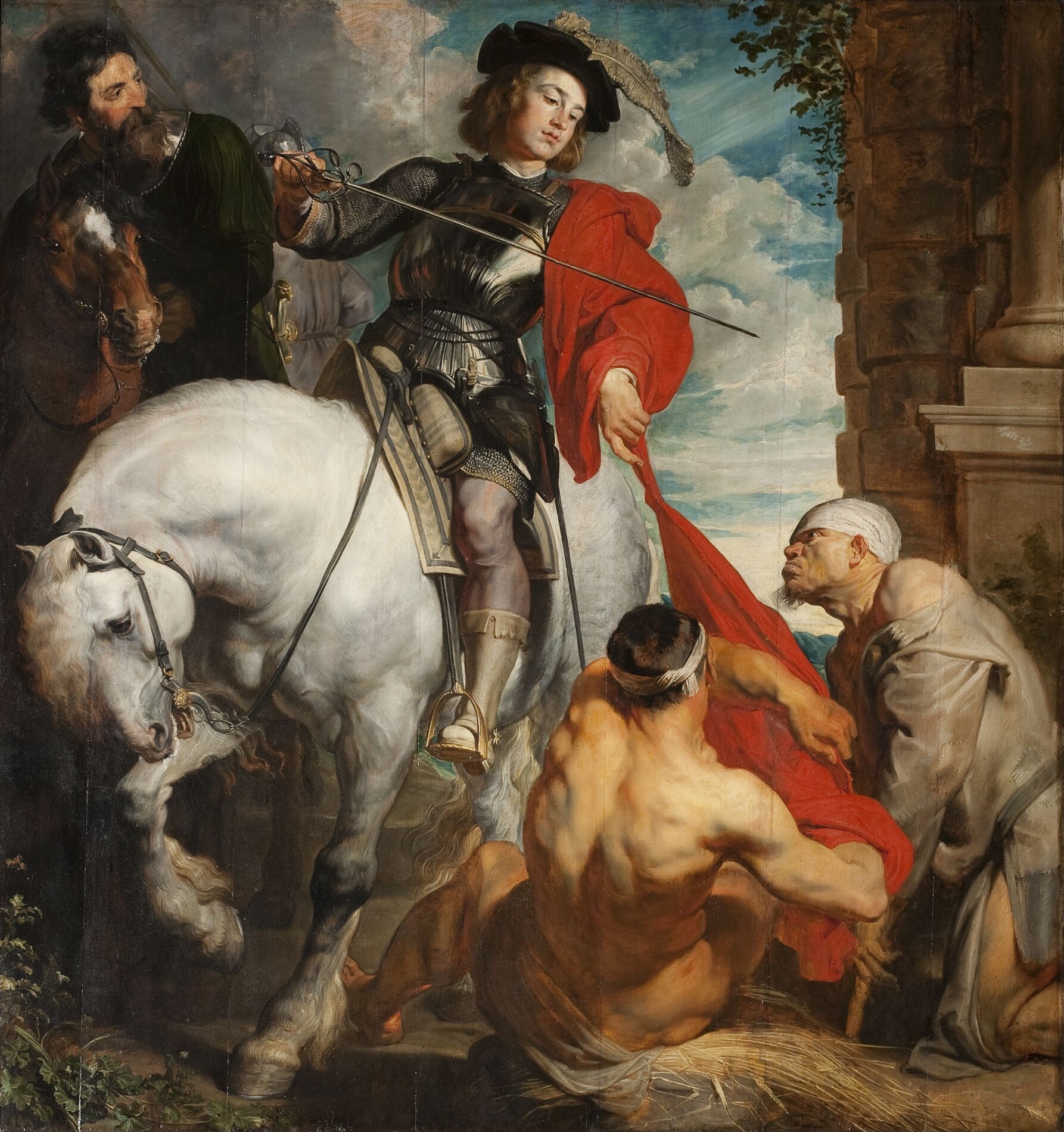
St. Martin is best known for the account of his using his sword to cut his cloak in two, to give half to a beggar clad only in rags in winter. While Martin was a soldier in the Roman army and stationed in Gaul, he experienced a vision, which became the most-repeated story about his life. One day as he was approaching the gates of the city of Amiens, he met a scantily clad beggar. He impulsively cut his military cloak in half to share with the man. That night, Martin dreamed of Jesus wearing the half of the cloak he had given away. He heard Jesus say to some of the angels, “Martin, who is still but a catechumen, clothed me with this robe.” (Sulpicius, ch 2). This was an example of Jesus’ parable in Matthew Chapter 25, differentiating the sheep from the goats:
 31 “When the Son of Man comes in his glory, and all the angels with him, he will sit on his glorious throne. 32 All the nations will be gathered before him, and he will separate the people one from another as a shepherd separates the sheep from the goats. 33 He will put the sheep on his right and the goats on his left. 34 “Then the King will say to those on his right, ‘Come, you who are blessed by my Father; take your inheritance, the kingdom prepared for you since the creation of the world. 35 For I was hungry and you gave me something to eat, I was thirsty and you gave me something to drink, I was a stranger and you invited me in, 36 I needed clothes and you clothed me, I was sick and you looked after me, I was in prison and you came to visit me.’ 37 “Then the righteous will answer him, ‘Lord, when did we see you hungry and feed you, or thirsty and give you something to drink? 38 When did we see you a stranger and invite you in, or needing clothes and clothe you? 39 When did we see you sick or in prison and go to visit you?’ 40 “The King will reply, ‘Truly I tell you, whatever you did for one of the least of these brothers and sisters of mine, you did for me.’ 41 “Then he will say to those on his left, ‘Depart from me, you who are cursed, into the eternal fire prepared for the devil and his angels. 42 For I was hungry and you gave me nothing to eat, I was thirsty and you gave me nothing to drink, 43 I was a stranger and you did not invite me in, I needed clothes and you did not clothe me, I was sick and in prison and you did not look after me.’ 44 “They also will answer, ‘Lord, when did we see you hungry or thirsty or a stranger or needing clothes or sick or in prison, and did not help you?’ 45 “He will reply, ‘Truly I tell you, whatever you did not do for one of the least of these, you did not do for me.’
This dream Saint Martin had was so profound that it altered the course of his life. It also became the defining symbol of Christian charity and is why he appears on the token, dividing his cloak for a beggar.
The part of the robe kept by himself became the famous relic preserved in the oratory of the Merovingian kings of the Franks at the Marmoutier Abbey near Tours. During the Middle Ages, the relic of St. Martin’s miraculous cloak (cappa Sancti Martini) was carried by the king even into battle, and used as a holy relic upon which oaths were sworn. The cloak is first attested to in the royal treasury in 679 when it was conserved at the palatium of Luzarches, a royal villa that was later ceded to the monks of Saint-Denis by Charlemagne, in 798/99.
The priest who cared for the cloak in its reliquary was called a cappellanu, and ultimately all priests who served the military were called cappellani. The French translation is chapelains, from which the English word chaplain is derived.
A similar linguistic development took place for the term referring to the small temporary churches built for the relic. People called them a “capella”, the word for a little cloak. Eventually, such small churches lost their association with the cloak, and all small churches began to be referred to as “chapels”.
Martin Luther (who initiated the Protestant Reformation) was named after St. Martin. Martin Luther taught that salvation is a gift from God, received through faith, not earned by good works. He also emphasized the Bible as the sole source of divine knowledge, challenging the authority of the Pope and church traditions. Source: https://en.wikipedia.org/wiki/Martin_of_Tours
For more information about the amazing life of Saint Martin and the eye witness accounts of the miracles and other acts he performed, see “Sulpicius Severus’ Life of Martin [Vita Martini] and Other Writings” translated from the original Latin here: https://archive.org/details/sulpicius-severus-writings/page/3/mode/2up
Leave a Reply